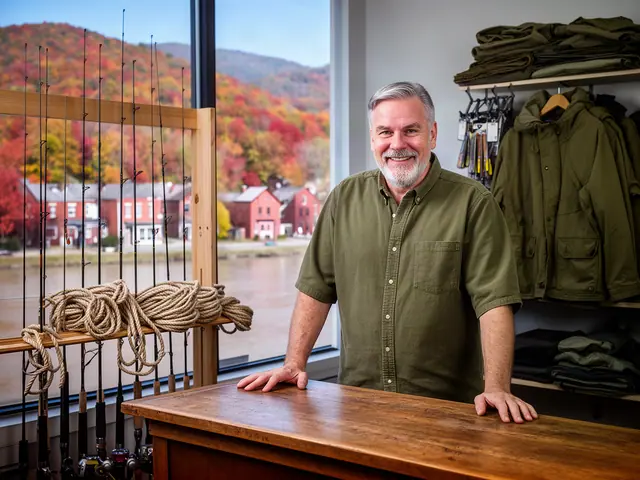
Quillhaven Financial in Huntington, West Virginia sends retail funding requests to funding partners. This page covers downtown shops, lighting and display upgrades, extra stock, small-store options, retail trade loans and Cabell County store counts by type.
At a glance
- Retail employers
Retail trade, Cabell County, WV: 396 employer establishments (CBP 2023)
- Office ZIP retailers
Retail trade, ZIP 25701: 105 employer establishments (ZBP 2023)
- Clothing stores
Clothing and clothing accessories stores, Cabell County, WV: 64 employer establishments (CBP 2023)
Retail Business Loans for a Downtown Huntington, WV Shop
A downtown shop carries three kinds of cost a lender sees: stock, the space and the people. Stock turns over in weeks or months; fixtures, signs and lighting last for years; payroll and rent come every month. Each points to a different funding type.
In ZIP 25701, 105 retail employers were counted for 2023, 32.4% of them with fewer than five employees (ZIP Code Business Patterns). A small shop's owner often signs personally for its debts, so a partner reads the owner's finances alongside the store's.
Inventory loans cover stock; a line of credit covers the months when sales lag behind costs; equipment financing covers the point-of-sale system, cases and coolers.
Business Loan for a Retail Store Updating Lighting and Displays
Lighting, shelving, display cases and signage change how a store sells, and they are long-lived, which makes them suitable for a fixed loan or equipment financing. A partner may treat installed fixtures as part of the building rather than as removable equipment, which affects their value as collateral.
Illustration only, invented figures: a store prices new LED lighting and display fixtures at $22,000. Financed over 36 months at an invented annual rate of 11%, the payment would be about $720 a month, and the total repaid about $25,929 (our arithmetic). This is not an offer.
Signs and some interior work need city permits in Huntington, WV; the zoning and permit guide lists them.
Small Business Loans for a Retail Store Carrying Extra Stock Into a Busy Stretch
A store that expects a busy stretch, such as a sale event or a school season, has to buy more stock weeks ahead and pay for it before customers arrive. A short loan or an inventory loan sized to that extra stock, repaid as it sells, keeps the purchase from draining the operating account.
Unsold stock is the danger. A partner reads past sales for similar periods to judge how quickly the extra stock is likely to move, and the store should plan how leftover goods will be cleared.
Retail Business Loans for Small Business Owners in Cabell County, WV
Of Cabell County, WV's 396 retail employers in 2023, 31.3% had fewer than five employees (County Business Patterns). Nonemployer Statistics counted a further 438 retail businesses without paid employees in 2024, measured separately.
Small stores have the same funding types available as larger ones, but often in smaller amounts and with a personal signature. A store with two or more years of sales records and steady card deposits has the most options; a newer one may start with equipment financing or a small line.
Retail Trade Loan Options for a Cabell County, WV Store
Retail trade loan is a broad phrase. In practice it means one of the six funding types used by a store: an inventory loan or line for stock, equipment financing for cases and registers, a term loan for a remodel or a purchase of another store, a short loan for a slow month, a line of credit for the cycle of the year, or a merchant cash advance for a card-heavy store needing a bridge.
Each is reviewed on the store's sales, margins and existing debt. The comparison page sets them side by side, and a merchant cash advance should always be compared with a loan in total dollars, since it is not a loan.
Clothing, Pharmacy and Auto Parts Counts Within Cabell County, WV Retail
Selected store types from County Business Patterns, 2023: 64 clothing and clothing accessories stores, 45 health and personal care stores (18 of them pharmacies and drug stores), 30 automotive parts, accessories and tire stores, 30 other miscellaneous store retailers, 28 general merchandise stores including warehouse clubs and supercenters, and 23 building material and garden equipment and supplies dealers. Gasoline stations, with 44, are among the groups not listed here.
Each type finances differently. A pharmacy holds high-value stock that is tightly tracked; a clothing store's stock changes with the seasons; a parts store mixes fast and slow movers. A partner weighs those differences in setting a limit or a borrowing base.
Stores can read revenue-based financing or an advance and how to get a loan to buy a business.
By Quillhaven Financial · Updated